

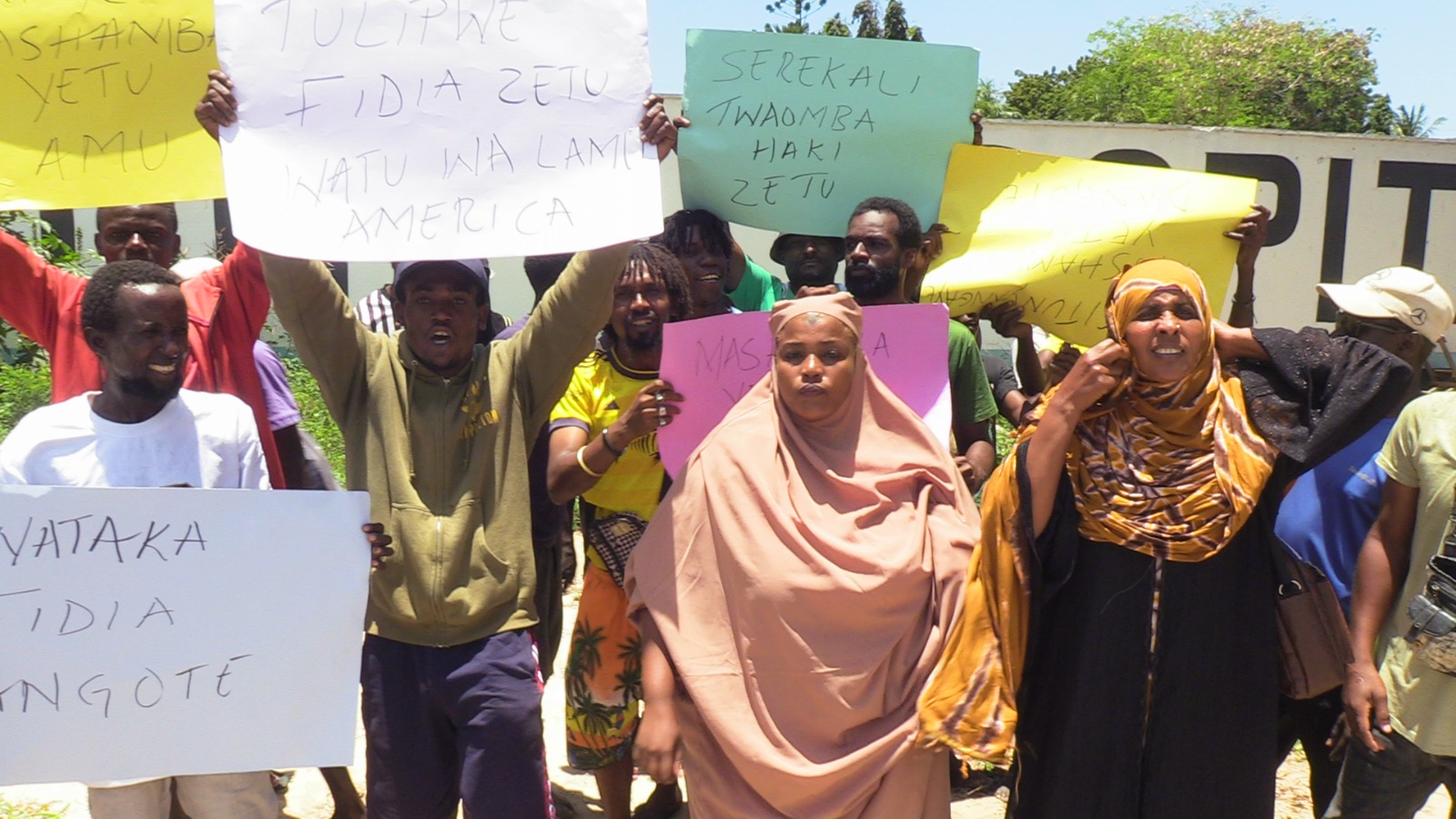
The much-touted KSh. 2 trillion Aliko Dangote oil refinery in Lamu County has yet again faced an impediment after a second group of Lamu residents moved to court to stop its launch scheduled for Wednesday September 30, 2026 by President William Ruto.
More than 133 residents of Chandavai area have moved to court seeking to stop what they termed as the unlawful takeover and destruction of land their families have occupied and cultivated for generations.
They claim to support the projects but on condition that their prayers are heard and their requests of a resettlement plan or compensation are met.
Speaking after filing a notice of motion at the Malindi Law Courts on Monday, the residents led by Suleiman Ali and Kanywa Kamunde said that they will only allow the project to proceed after compensation.
The 133 plaintiffs have sued the Office of the President, the Cabinet Secretary for Defence, the State Department for Lands and Physical Planning, the Attorney General, the National Land Commission (NLC), the Lamu Port-South Sudan-Ethiopia Transport (LAPSSET) Corridor Development Authority, the Lamu County Government and Dangote Industries, together with two companies described as contractors.
The residents claim they have, for generations, occupied, cultivated and developed identifiable portions of land comprised in or forming part of LR No. 13061 in Chandavai.
They have asked the court to intervene, arguing that continued construction and excavation would cause further destruction of crops, trees, homes and other property and permanently alter the character of the disputed land.
“Continued construction or excavation will cause further destruction of crops, trees, structures and other property and will materially alter the physical character of the land, thereby making the dispute substantially more difficult to resolve,” the plaintiffs state in court documents.
The residents claim that families have historically used the land for farming and livestock keeping and have built homes, mosques and shrines on it. Some family members, they say, are also buried on the disputed land.
The plaintiffs contend that the land is community land under the stewardship of the Lamu County Government and that they occupied it peacefully for generations without previous disputes over ownership.
They argue that some of the property at risk cannot be adequately compensated through monetary damages.
“Some of the affected property cannot readily be replaced by monetary compensation, particularly ancestral and family homes, graves, trees, long-standing occupation sites and community structures,” they claim.
The residents allege that on August 7, 2024, officers and agents associated with the national government and LAPSSET entered the disputed land with heavy machinery and bulldozers.
They claim crops, trees and other property were destroyed without prior notice, consultation or compensation.
According to the plaintiffs, local administrators subsequently informed them that the land had previously been acquired by the government for the LAPSSET project and later allocated to the Ministry of Defense for infrastructure works around Manda Bay.
The works, they allege, included road construction and expansion of facilities around the Kenya Navy Base at Manda Bay, US Camp Simba and Magogoni Airfield.
Some residents claimed that they were instructed not to interfere with the works and were promised compensation for destroyed crops and other losses.
They added that some families were forced to move into rented accommodation to make way for the developments.
The residents allege that soil testing and other preparatory activities linked to the proposed refinery began in July 2026 and that local administrators subsequently told them that the Dangote project would proceed alongside the LAPSSET and Manda Bay infrastructure developments.
They also said that on September 10, 2026, police officers, chiefs and other government agents cleared one of the disputed parcels, telling them that the site would be used for a groundbreaking ceremony for the refinery.
They added that they learnt around September 20 that the government had commenced a compulsory acquisition process involving land in Lamu alleging that the process is intended to compensate absentee landowners whose titles they claim were unlawfully or fraudulently obtained, while excluding residents who have actually occupied and used the land for generations.
According to the residents, the absence of registered title deeds does not extinguish their interests in the land or their entitlement to compensation.
They rely, among other provisions, on Article 40(4) of the Constitution and the compulsory acquisition provisions of the Land Act.
The plaintiffs say the alleged conduct violated several constitutional rights, including the right to property under Article 40, the right to fair administrative action under Article 47 and the right of access to information under Article 35.
They have also raised environmental concerns, alleging that the defendants failed to comply with requirements under the Environmental Management and Co-ordination Act and applicable environmental assessment procedures.
Their case is that government agencies cannot lawfully take possession of land, displace occupants and destroy their property before commencing or completing the compulsory acquisition process.
According to them, lawful acquisition requires identification of the affected land and persons with interests in it, issuance of statutory notices, an inquiry, valuation and assessment of compensation, followed by payment or lawful deposit of the compensation before possession is taken.
The case places long standing claims of customary and community occupation in Chandavai at the centre of competing infrastructure and industrial development plans in Lamu, including LAPSSET related projects, military infrastructure around Manda Bay and the proposed Dangote refinery.