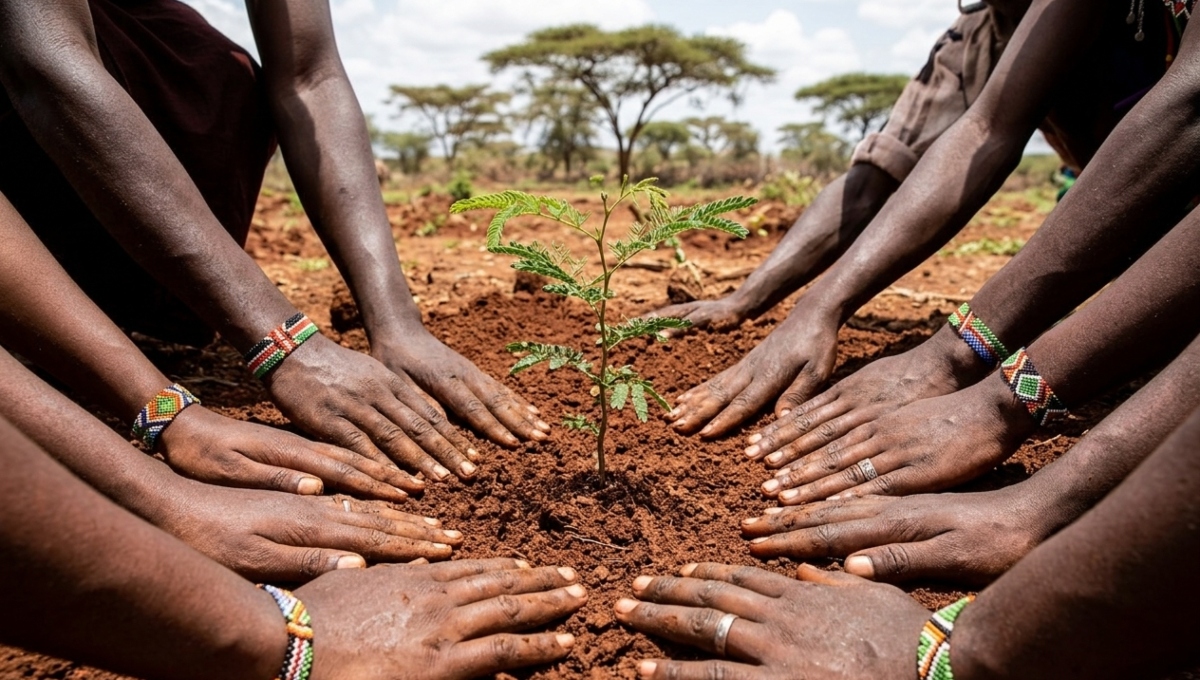
Kenya’s ambition to plant 15 billion trees by 2032 is often framed as an environmental mission. Less discussed is the economic opportunity emerging alongside it. As demand grows for billions of seedlings, restoration services, landscaping expertise and ecosystem-linked enterprises, a new generation of entrepreneurs is proving that tree growing is not only good for the environment – it may also be one of the country’s most significant emerging business opportunities.
For years, tree planting in Kenya has largely been viewed as a conservation activity. Today, it is increasingly becoming a market.
Behind Kenya’s national target of planting 15 billion trees by 2032 lies a vast economic ecosystem. Every tree requires a seedling. Every seedling requires production, labor, water, transport, technical expertise and access to customers. At the scale required to meet the national target, the result is growing demand for nurseries, restoration contractors, landscapers, irrigation suppliers, environmental consultants and ecosystem-linked enterprises.
According to the Government of Kenya’s 15 billion Tree Growing Program, the country aims to restore 10.6 million hectares of degraded landscapes by 2032 through a whole-of-society approach involving government, communities, development partners and the private sector. Based on the program’s implementation timeline, Kenya will need to establish approximately two billion trees annually over the remaining implementation period to remain on track.
For entrepreneurs, that represents more than an environmental challenge. It represents a commercial opportunity. Few illustrate that opportunity more clearly than 26-year-old Francis Mutisya.
From Ksh 1,800 to a multi-million-shilling enterprise
Mutisya’s journey began with an investment of just Ksh1,800. Using the money to purchase filling papers and nurture seedlings collected around his family home, he established a small nursery in Machakos County.
Today, according to figures he provided, the business can accommodate up to 30,000 seedlings at any one time and produces between 120,000 and 180,000 seedlings annually. Indigenous tree seedlings retail for between Ksh20 and Ksh40, grafted fruit trees for between Ksh150 and Ksh200, while ornamental trees can fetch between Ksh200 and Ksh600 depending on species and maturity.
The strongest demand is increasingly coming from ornamental and landscaping varieties, reflecting growth in real estate development, institutional landscaping and environmental restoration projects.
What makes the business particularly noteworthy is its economics.
Based on production and sales figures provided by Mutisya, annual revenues from seedling sales are estimated at between Ksh9.6 million and Ksh14.4 million. Landscaping contracts generate additional revenues of between Ksh80,000 and Ksh150,000 per assignment.
What began as a backyard operation has evolved into a growing enterprise serving customers through both a home-based nursery in Kathiani and a sales outlet in Machakos Town.
For investors seeking evidence that restoration can generate commercially viable businesses, Mutisya’s enterprise offers a compelling proof of concept.
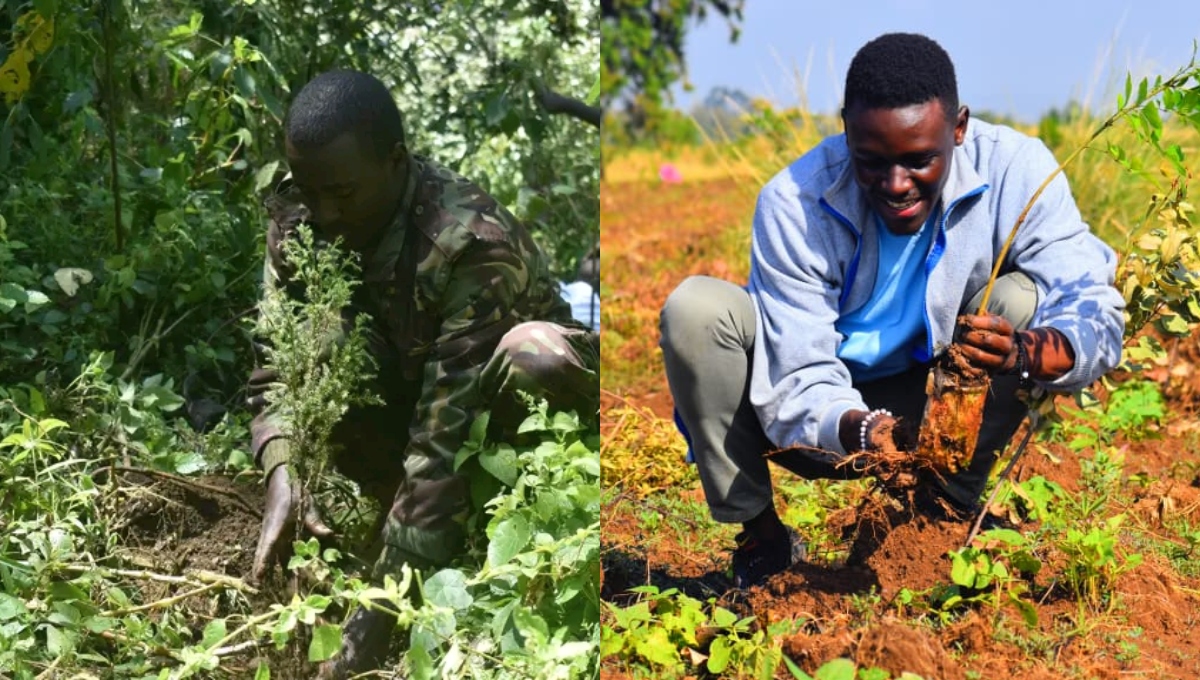
A Market Moving Beyond Tree-Planting Days
One of the clearest signs that tree growing is evolving into a genuine market is the changing nature of demand.
According to Mutisya, his customers include individual homeowners, farmers establishing orchards, schools, churches, property developers, landscaping contractors and county government projects. In a typical month, the nursery serves more than 30 customers, with approximately 60 percent returning for repeat purchases. Average orders stand at around 100 seedlings, although larger institutional buyers frequently purchase between 1,000 and 2,000 seedlings in a single transaction.
This shift is significant.
It suggests that demand is no longer concentrated around annual tree-planting campaigns. Instead, tree growing is increasingly being driven by agriculture, construction, landscaping, education and public-sector procurement.
As demand becomes more consistent, entrepreneurs are beginning to treat nursery production as a year-round business rather than a seasonal activity.
That trend has implications far beyond the nursery sector itself.
A growing restoration economy creates demand for seed suppliers, irrigation equipment, water storage systems, transport services, landscaping contractors, environmental consultants and restoration specialists.
Each represents a potential investment opportunity within a rapidly evolving value chain.
The Financing Gap
Despite growing demand, access to capital remains one of the sector’s biggest constraints. Many nursery operators start with personal savings and expand gradually over time. Yet scaling requires investment in irrigation systems, water infrastructure, transport, land preparation, nursery facilities and skilled labor.
The challenge is not demand. The challenge is finance.
For commercial banks, development finance institutions, impact investors and corporate sustainability programs, this presents an opportunity to support enterprises operating at the intersection of environmental restoration and economic growth.
As Kenya’s restoration agenda accelerates, access to growth capital may become one of the key factors determining whether promising small enterprises are able to scale into nationally significant businesses.
The Economics of Survival
Producing seedlings is only part of the equation.
Ensuring that planted trees survive may ultimately determine the long-term value of Kenya’s restoration efforts.
Brian Otieno, a Project Officer with the Laikipia Wildlife Forum, has spent the past several years supporting restoration programs across multiple counties. His experience revealed a challenge often overlooked in large-scale tree-growing initiatives: survival rates.
Many programs focus on the number of trees planted rather than the number that survive.
For investors and institutions funding restoration projects, the distinction matters.
A living tree generates environmental and economic returns. A dead tree represents a lost investment.
To address the challenge, Otieno launched the Adopt a Tree Campaign, which encourages schoolchildren to take responsibility for individual trees after planting.
According to Otieno and the Laikipia Wildlife Forum, the campaign has reached 32 schools and facilitated the planting of more than 50,000 trees since 2023. The initiative combines environmental education with species-site matching, ensuring that trees are planted in locations where they have the highest likelihood of survival.
The lesson is simple. The economics of restoration depend not only on planting more trees but on ensuring those trees survive long enough to create value.
When Restoration Creates New Enterprises
The commercial potential of restoration extends well beyond seedling production.
In Laikipia County, the Dupoto Beekeepers and Marketing Cooperative Society demonstrates how healthier ecosystems can support entirely new business opportunities.
According to the cooperative, it comprises 220 members managing approximately 700 hives and producing an estimated 30,000 kilograms of honey annually. Cooperative leaders estimate annual revenues of approximately Ksh 30 million, with honey selling for around Ksh 1,000 per kilogram.
The cooperative supplies hotels and hospitality establishments in Nanyuki, individual consumers and customers reached through agricultural exhibitions and trade fairs.
Its growth highlights an important reality.
The commercial value of restoration is often found not only in the trees themselves but in the businesses that emerge around healthier ecosystems.
Honey production, seed collection, fruit processing, eco-tourism, landscaping and environmental contracting all represent economic activities that can grow alongside restoration efforts.
What Investors Should Watch
For investors, the significance of Kenya’s restoration agenda extends far beyond environmental outcomes.
The country’s tree-growing target is creating predictable demand for seedlings, restoration services, irrigation systems, landscaping expertise and ecosystem-linked enterprises.
Unlike many emerging sectors, demand is being driven simultaneously by government policy, public institutions, communities, development programs and private sector actors.
That combination creates a foundation for sustained market growth.
The businesses best positioned to benefit may not necessarily be those planting the trees. They may be the enterprises supplying the inputs, services and expertise required to make restoration possible at scale.
The question is no longer whether restoration can create economic value.
Entrepreneurs such as Francis Mutisya and organizations such as the Dupoto Cooperative are already demonstrating that it can.
The more important question is who will build, finance and scale the businesses needed to support one of Africa’s most ambitious restoration programs?