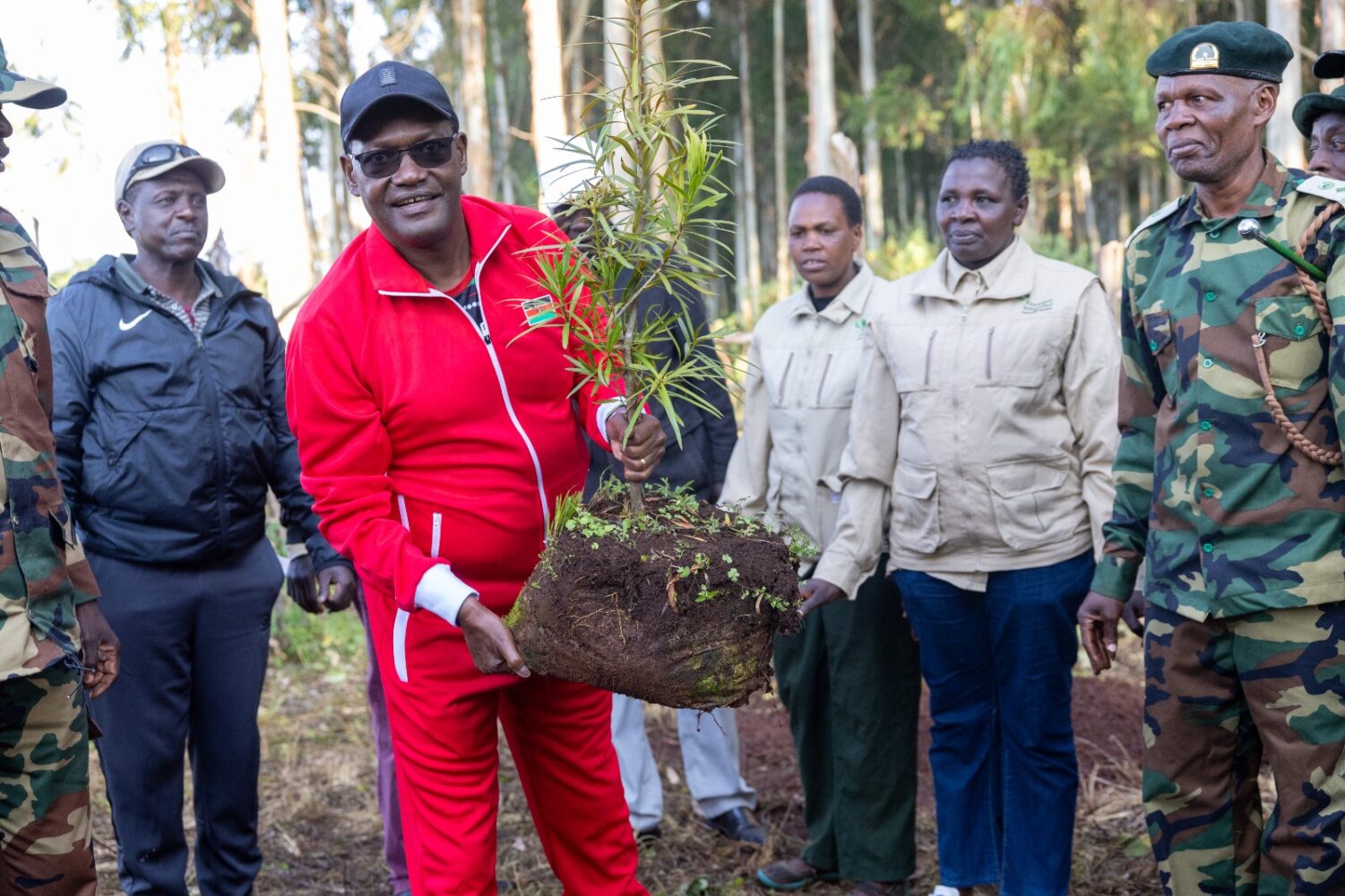
Many have wondered why National Treasury Principal Secretary Dr. Chris Kiptoo has remained at the centre of the Kaptagat Integrated Conservation Programme (KICP), dedicating more than a decade to restoring one of Kenya’s most important water towers.
Born and raised in Kapkoi village in Elgeyo Marakwet County, just a few kilometres from Kaptagat Forest, Kiptoo says the forest shaped his upbringing and sustained his family long before he joined government.
The answer, he says, lies in his childhood.
As a young boy, he grazed livestock inside the forest and helped his parents cultivate crops under the Shamba System, where communities were allowed to farm after forest harvesting.
Back then, he recalls, the forest was abundant, and life was easier.
“At that time, life was easy. We were able to take many animals. We had sufficient land.” But as he grew older, he witnessed the gradual destruction of the forest that had sustained generations.
“I could see that the same forest was getting degraded.” After completing university, the reality became even clearer. “I could clearly see that if we continue without doing anything, then clearly, we are likely to lose the importance of the forest, because most of it will be degraded.”
Rather than wait for someone else to act, Kiptoo says he resolved to begin with his own community.
“I often say that change begins from where you are.”
He started by mobilising local residents to restore water sources and rehabilitate degraded sections of the forest.
His appointment as Principal Secretary in 2015 gave him a platform to expand those efforts.
“When I was appointed principal secretary in December 2015, I felt maybe now that I am a senior man in government, I could also use the opportunity as a PS to galvanise more supporters to come for restoration.”
Two years later, in 2017, he launched what became the first edition of the Kaptagat Integrated Conservation Programme. “The mission was to restore degraded forest and to restore livelihoods.”
Today, that journey has reached a major milestone.
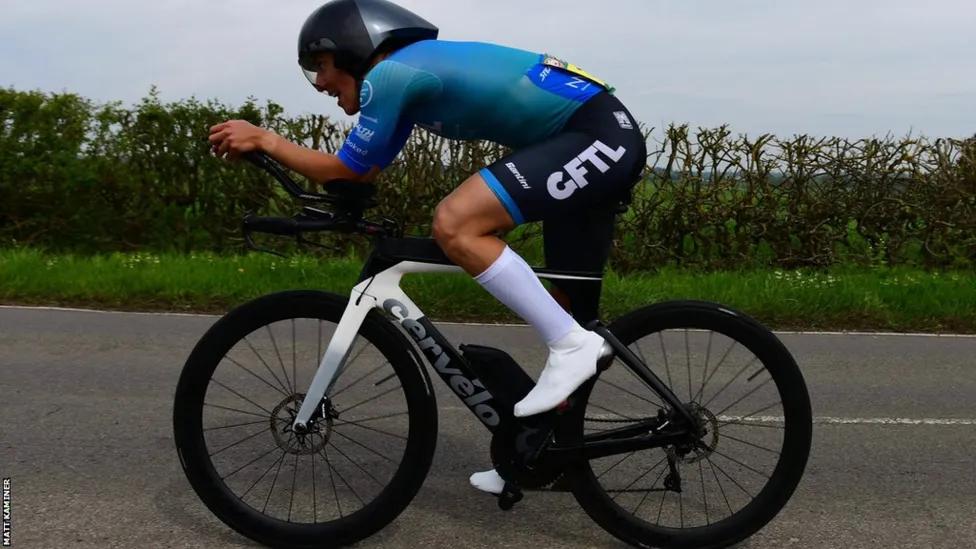
The 2026 Kaptagat Cycling Challenge, one of the flagship build-up activities to the programme’s 10th anniversary celebrations, brought together hundreds of cyclists, conservation partners, government leaders and local communities to celebrate a decade of restoration through sport and environmental stewardship.
Congratulating participants, Kiptoo said the event demonstrates how sport can strengthen conservation efforts.
But for Kiptoo, restoring forests has never been about trees alone.
He says the programme was deliberately designed around four pillars: restoring forests (Mazingira Bora), expanding access to clean water (Maji Safi), promoting clean energy (Kawi Safi) and creating sustainable livelihoods (Pesa Mfukoni).
His belief is simple: communities will only protect forests if conservation improves their lives.
“Without the people, the program of restoration is useless. We must put the people at the center of this.”
That philosophy has seen the programme promote dairy farming, coffee, tea, avocado, macadamia and other high-value crops while supporting households to adopt clean energy and reduce dependence on firewood.
Looking back after ten years, Kiptoo says the progress extends far beyond tree planting. “I see so much progress in restoring degraded forest and also in restoring livelihoods.”
He now wants the next decade to transform Kaptagat into a world-class conservation, sports and ecotourism destination.
“Kaptagat is a high-altitude area for athletes. We want to work with Kenya Forest Service now to make sure that this forest is also a place for running. We also want nature trails. We want bicycles. People should be coming from Eldoret… and do riding as we do in Karura.”
He envisions visitors paying to enjoy the forest, creating income that flows directly back to surrounding communities.
“You get into the forest; you leave something small. That will go back to the community. And I think it is going to be a win-win.”
Kiptoo also wants every household around Kaptagat to become financially self-reliant through commercial agriculture linked to international markets.
“There is demand for our products. But we don’t have sufficient products.”
His long-term ambition, he says, is for communities that once depended on aid to become prosperous enough to support others.
“My vision is that not so far from now, every household will be having income.”
As the Kaptagat Integrated Conservation Programme enters its second decade, Kiptoo believes the initiative has grown beyond a local restoration project into a national blueprint for environmental conservation and rural transformation; however, it remains deeply personal, a promise to protect the forest that nurtured him as a child and to ensure future generations inherit a healthier ecosystem than the one he watched decline.