
At a gathering to mark International Widows Day in Nairobi, one pattern became impossible to ignore: many of the women had lost their husbands not to illness or crime, but to what many, if not all, routinely call “road accidents.”
The stories began differently but ended the same way. One husband was driving to Nairobi with a load of vegetables. Another was returning home from work. A third was ferrying a passenger on a motorcycle when a speeding vehicle struck him. Then came the phone call. The hospital. The morgue. The funeral.
As hundreds of widows gathered this week, conversations about inheritance rights, financial hardship and social stigma quickly gave way to a recurring theme: Kenya’s roads. Again and again, widows stood up to explain how they joined a club they never wanted to belong to. Their husbands had been killed in what police reports described as “road accidents.” Yet listening to their stories, one question lingered: how many of these deaths were truly accidents?
The phone call that changed everything
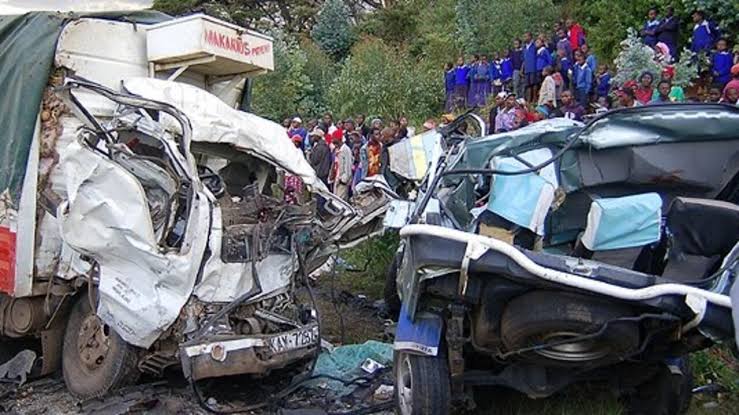
For Lucy Achieng’, widowhood arrived on a Thursday afternoon. Her husband had boarded a bus travelling from Kisumu to Nairobi. Somewhere near Salgaa, the bus collided with a trailer after an overtaking manoeuvre went wrong. The crash killed several passengers.
Police described it as an accident. Lucy disagrees. “What was accidental about speeding?” she asks quietly. “What was accidental about overtaking where drivers know they shouldn’t?”
For six years she has raised three children alone. The youngest barely remembers his father. The oldest abandoned university plans to help support the family. When road safety statistics are released, Lucy sees something others may not. She sees faces.
When language hides responsibility
The distinction between a crash and an accident may appear insignificant. To road safety experts, it is anything but.
An accident suggests a random event, something unavoidable. A crash suggests a cause. And if there is a cause, there is accountability.
“Language shapes how societies understand responsibility,” says Dr. Esther Naliaka, an anthropologist. “When we call something an accident, we culturally position it as fate or misfortune. The word itself implies nobody could have prevented it.”
According to Dr. Naliaka, the widespread use of the term road accident has helped normalize road deaths in Kenya. “Many communities have come to view road deaths as inevitable. When a crash occurs, the conversation often moves quickly to condolences and burial arrangements rather than asking what decisions, behaviours, or institutional failures contributed to the death.”
She argues that language influences how citizens and policymakers respond. “If a bus overturns because a driver was speeding, if a pedestrian is killed because there is no safe crossing, or if a truck collides due to poor maintenance, describing the outcome as an accident obscures the chain of events. A crash forces us to ask harder questions about accountability.”
The widows gathered in Nairobi may not use technical terminology. But many instinctively understand the distinction. Their husbands did not die because lightning struck. They died in collisions that followed identifiable patterns.
A pattern written in the statistics
According to the National Transport and Safety Authority (NTSA), 4,748 people died on Kenyan roads in 2024, up from 4,324 the previous year. The trend continued into 2025, with fatalities increasing despite repeated road safety campaigns and enforcement operations.
Pedestrians and motorcyclists remain the most vulnerable road users. Pedestrians accounted for nearly four out of every ten fatalities recorded in early 2025. Motorcyclists followed closely behind.
Road engineers point to a deeper problem: many roads are designed primarily for moving vehicles rather than protecting people. In towns across Kenya, highways cut through schools, trading centres, and residential neighbourhoods. Pedestrians navigate fast moving traffic because footpaths are absent. Footbridges are often too far apart or poorly positioned. Motorcyclists share roads with trucks designed for entirely different operating conditions.
The resulting deaths are then recorded as accidents. Yet experts argue they are often the predictable outcome of infrastructure choices. “Road deaths are usually the final point in a chain of failures,” says a transport planner who declined to be mentioned due to the sensitivity of the position he holds in government. “The driver may make the final mistake, but the system frequently creates conditions where that mistake becomes fatal.”
The cost of a crash lasts longer than the crash
For Miriam Njeri, the collision that killed her husband lasted only seconds. The aftermath has stretched over four years.
Her husband was struck by a speeding vehicle while crossing a road near Mlolongo. The driver survived. The court case remains unresolved. The family’s financial stability disappeared almost overnight.
“When people hear about crashes, they think about the people who died,” she says. “They don’t think about the people left behind.”
At the Widows Day gathering, that sentiment echoed repeatedly. Many women described withdrawing children from private schools. Others sold land to cover medical bills incurred before their husbands died. Several reported prolonged battles with insurers. One widow said she still cannot answer unknown phone numbers without anxiety.
The crash ended in a moment. The consequences continue.
A national emergency hiding in plain sight
The Ministry of Transport estimates road crashes cost Kenya hundreds of billions of shillings annually. But the human cost remains harder to quantify. How do you measure a childhood without a father? Or a widow forced to rebuild her life because a driver ignored a speed limit? Or a family pushed into poverty because a breadwinner never made it home?
If 13 Kenyans died every day from a plane crash, the country would likely declare a national emergency. Yet roughly the same number die daily on the roads. The difference is that road deaths occur one by one, scattered across highways, towns and villages. Their cumulative impact is enormous. Their visibility is not.
As the women dispersed at the end of International Widows Day, many carried framed photographs of husbands they lost years ago. Official records classify those deaths as accidents. The widows’ stories suggest something different. Not bad luck. Not fate. But preventable crashes whose consequences continue long after the wreckage has been cleared.