For more than seven decades, KenGen has measured itself in megawatts.
Now, for the first time, the State-owned power producer is trying to measure something far less tangible: its impact on the planet, the communities around its power plants and, perhaps most revealingly, the risks that could determine whether Kenya’s clean-energy ambitions succeed or stall.
The company’s inaugural Sustainability Report, released Monday, is a blueprint for the next decade of Kenya’s energy transition.
Buried inside are ambitious targets, uncomfortable admissions and billions of shillings’ worth of climate and investment bets.
KenGen wants to add 5,500 megawatts of new renewable energy capacity by 2034, more than three times its current installed generation portfolio, and position itself as Africa’s leading renewable energy solutions provider. That expansion includes geothermal developments, battery storage, a green industrial park in Olkaria and, significantly, operating Kenya’s first nuclear power plant.
Yet the report is equally candid about the headwinds.
Among the biggest are climate variability affecting hydropower generation, increasingly complex environmental regulations, biodiversity protection obligations, cyber-security threats, evolving ESG expectations from investors, ageing infrastructure, financing pressures for large capital projects and changing electricity demand patterns.
KenGen also identifies operational risks associated with geothermal exploration, which remains costly and technically uncertain, as well as broader macroeconomic risks including inflation, exchange-rate volatility and supply-chain disruptions.
Those risks matter because Kenya has staked much of its climate credentials on renewable energy.
According to the report, 94.4% of KenGen’s electricity dispatch now comes from renewable sources, primarily geothermal, hydro and wind.
That places Kenya among countries with some of the cleanest electricity mixes globally.
The company says its operations generated 6.9 million carbon credits during the reporting period while supporting Kenya’s broader commitment to achieve a fully renewable electricity system by 2030 and net-zero emissions by 2050.
But KenGen argues sustainability is no longer simply about producing green electricity. Increasingly, investors are asking how companies govern themselves, protect biodiversity, manage communities and disclose environmental impacts.
That shift explains why sustainability reporting is becoming almost as important as financial reporting.
The report attempts to show KenGen as more than an electricity producer.
It details investments in education programmes, healthcare, community water projects and local enterprise development around power stations.
The company also says it intends to expand landscape restoration efforts to nine million trees by 2034, building on years of ecosystem conservation around its geothermal and hydro installations.
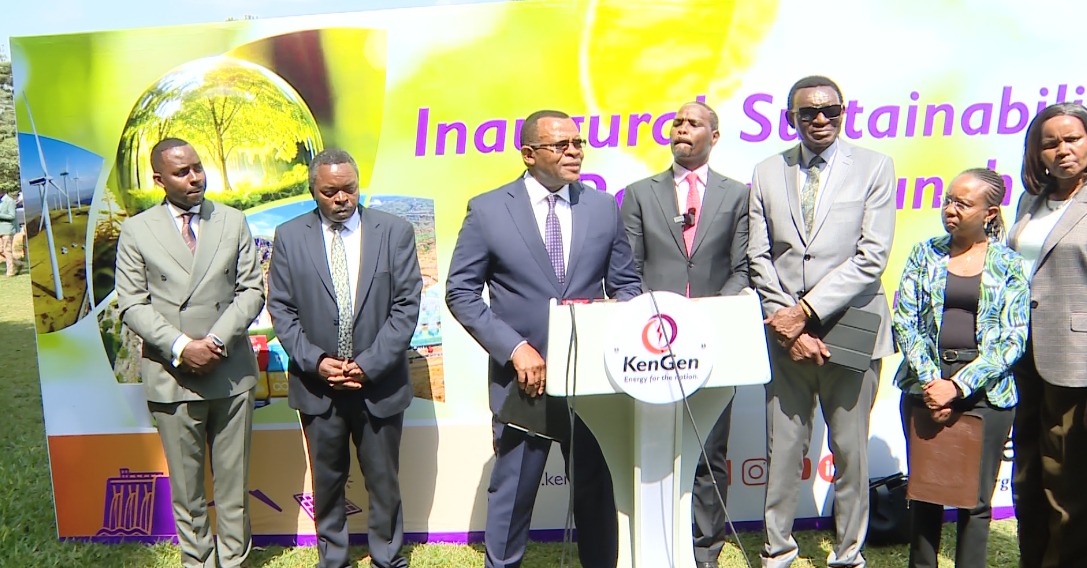
During the launch, Environment and Climate Change Principal Secretary Dr. Festus Ng’eno described the energy sector as the only major economic sector currently on track to meet Kenya’s climate commitments under its Nationally Determined Contributions, contrasting it with agriculture, transport and waste management, which continue to lag behind.
He challenged more public institutions to publish sustainability reports, saying they will increasingly become essential inputs into Kenya’s national State of the Environment Report.
For decades, utilities measured success by electricity sold. KenGen is now arguing that future value will also be measured by carbon reductions, restored ecosystems, resilient communities, transparent governance and investor confidence.
Chief Executive Engineer Peter Njenga described sustainability as “embedded” in every investment decision rather than existing as a standalone corporate programme, calling the report a public commitment to transparency and accountability.